About us Task Force on Climate-related Financial Disclosures report 2025

The Task Force on Climate-related Financial Disclosures (TCFD) was set up by the government to encourage businesses like ours to report on the financial risks and opportunities from climate change for your pension savings.

Woman smiling Wearing White Blouse Cropped to Size

1 April 2024 – 31 March 2025

Our fourth Task Force on Climate-Related Disclosures (TCFD) report summary sets out the investment decisions we’ve made to address climate change-related risks and opportunities within the investments we manage for our members. This includes how we consider, target and measure the actions we’re taking.

Why do we produce a TCFD report?

The Task Force on Climate-related Financial Disclosures (TCFD) was set up by the government to encourage businesses like ours to report on the financial risks and opportunities from climate change. We believe tackling climate change is essential and as a leading pensions Master Trust, we have a vital role to play. This report is a chance to share what we have been doing to ensure your pension savings are contributing to a more sustainable world. You can read our full report.

Read the full 2025 TCFD report

download-bottom

What is causing climate change?

Climate change is caused by human activity which releases greenhouse gases (GhG) into the atmosphere. These gases include carbon dioxide, methane and nitrous oxide, which trap the sun’s heat within our atmosphere much like a green house, and this causes global warming.

The European Copernicus Climate Change Service estimated that global average temperatures in 2024 were 1.6°C higher than before the industrial revolution. And, after the hottest year on record in 2023, 2024 was even hotter.

This may not sound like a big change, but its effects are unevenly spread across the globe and small changes can lead to big variations in local weather and climate conditions. A warmer temperature can lead to increased frequency of extreme weather events like droughts, floods, heatwaves and wildfires and affects nature and people as we struggle to adapt to rapid changes. Each 0.1°C increase above 1.5°C dramatically increases to projected costs of climate change to our global economy.

What is Net Zero?

Each year, human activity leads to about 54bn tonnes of GhG emissions globally. Most come from activities like energy production, transport, industry (cement, steel and plastics), and agriculture, particularly in animal farming and the use of fertilizers.

A lot of GhG emissions are absorbed naturally through the oceans and through nature, for example in the growth of trees. However, increasing concentrations in the atmosphere so quickly means we are overwhelming nature’s ability to absorb these emissions.

To stop climate change, we need to reduce man-made GHG emissions to a level that nature can absorb within its normal capacity, referred to as Net Zero. It does not mean no man-made emissions, it means a level that nature can absorb. This also highlights the crucial link between managing climate risks and reducing nature and biodiversity loss.

How does climate change affect my investments?

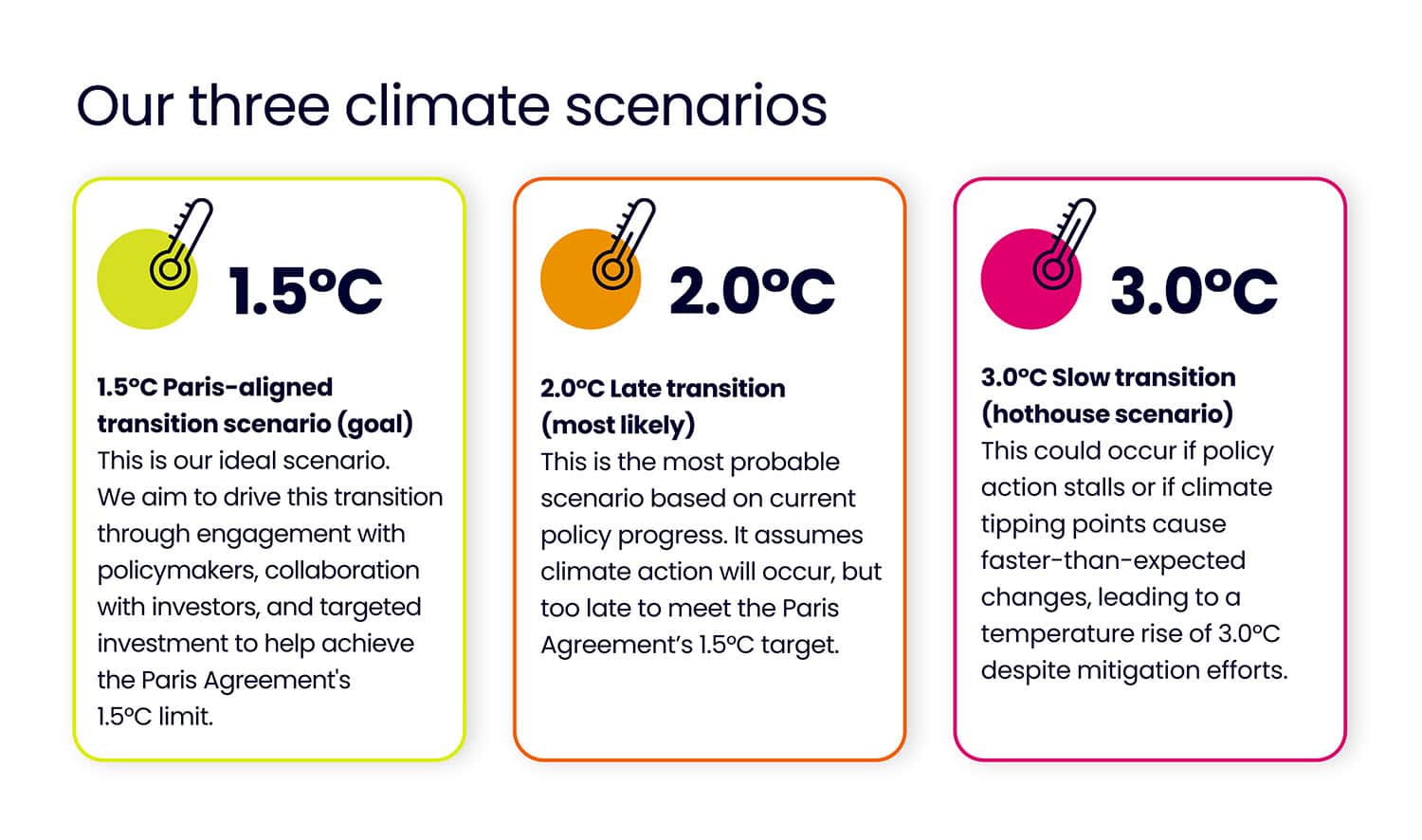
In trying to understand how climate change might affect your pension savings, we evaluate the potential impacts of three different climate scenarios over different timeframes. More information on the impact of risk across different time periods in different warming scenarios is set out in the full TCFD report.

On the evidence we’ve seen, we believe the severity and frequency of weather events caused by climate change will increase in all the scenarios above in the coming decade.

A 1.5°C or 2°C scenario is likely to be much more favourable to your investment portfolios and therefore, your pension savings. If coordinated policy action is taken (an increasingly unlikely scenario), this is likely to support economic growth driven by both the investment required, and decreased risks for investors that come with consistent, supportive policy. We therefore think the 1.5°C scenario will be positive for the portfolio over the medium-term time horizon.

However, in the 2°C and 3°C scenarios, we believe a warmer world could negatively impact global economic growth and potentially lead to higher inflation. With a 3°C or higher warming scenario, the economic consequences are likely to be dire. This means that investments are likely to perform poorly.

What we’re doing to address climate change

We believe it’s in our members’ best long-term financial interests to do what we can to limit the rise of global temperatures to as close to 1.5°C above pre-industrial levels as possible. There is a limit to what we can achieve on our own, but we aim to work together with other like-minded investors who share our concerns about the long-term financial risks of climate change and nature degradation.

We take several key actions to help achieve this:

  1. Engage and influence the companies we’re invested with, to develop transition plans to increase the likelihood of them achieving net zero by 2050.
  2. Engage with policy makers, regulators, and other stakeholders, to support policies that will increase the likelihood of achieving net zero by 2050.
  3. Assess the companies in which we invest and exclude or resize investments where necessary. We are prepared to disinvest where we believe companies’ strategies result in unacceptable financial risks because they are not committing to transition quickly enough.
  4. Identify climate-related investment opportunities which offer both financial returns and a positive contribution to a faster transition to net zero, such as investing in green bonds that finance a range of climate friendly projects.
  5. Our investment manager Cardano, who manage our portfolios, are members of several industry organisations that support and inform our climate change approach, including the PRI (United Nations-supported Principles for Responsible Investment), the IIGCC (Institutional Investors Group on Climate Change) and Pensions for Purpose. We are also members of the Asset Owners Council. We also support several collaborative initiatives that aim to engage with companies on environmental action, including Climate Action 100+, and the PRI Spring Initiative which is focused on tackling deforestation.
  6. Committing to long-term targets within our investment portfolios, including eliminating net zero greenhouse gas emissions by 2050, with 50% emissions reduction by 2030 based on 2019 levels, and investing at least 75% of the portfolio’s investments in assets which support the Trustee’s Responsible Investment beliefs by having an explicit responsible investment objective.

How our strategy has developed in 2025

We continue to monitor – and further enhance where necessary – the effectiveness of the investment strategy we agreed in 2023 and launched in 2024. This strategy embeds environmental, social and governance (ESG) factors, as well as real-world sustainability impact, into our investment approach.

Our primary approach to achieving real-world impact is through our engagement and stewardship of the companies we invest in. Through our investment manager Cardano we are involved in many initiatives to engage with our investee companies on their commitments regarding climate change, water use, supporting biodiversity and tackling deforestation; and their wider social impacts, particularly living wage and gender diversity.

We continue to work towards all of these objectives and remain on track to meet our Net Zero targets by 2050 with a 50% reduction by 2030 based on 2019 levels. We’d like to see the world decarbonise even more quickly than this, but the reality is that global GhG emissions have yet to peak, let alone decrease in-line with the pathway we’ve set out. So, we’ll keep engaging with our companies, reviewing these targets and our progress.

Through our strategy, now:pensions’ investments and your pension savings are now less carbon intensive and contributing to a more sustainable world.

How we measure our impact

To measure our impact, we carry out ongoing assessments of our targets and metrics to ensure we stay true to our principles. Over the past year we have developed our climate dashboard to provide real time data allowing us to see the effectiveness of our strategy.

We monitor key indicators against our benchmarks, such as our carbon footprint , our GhG emissions, the GhG emissions we have avoided through our investments and how the companies we invest in are using land to promote and protect biodiversity. Read the full report  for all the metrics we track.

Our progress

We report against four climate change metrics.

Metric 1: total greenhouse gas emissions

Our 2025 emissions for GHG Scope 1 and 2* are 203,828 tCO2e for investments in corporate equity and credit. This is the total GHG emissions, in tons of carbon dioxide equivalent, of Scope 1 and 2 emissions. There has been an uplift from last year (194,322) due to an increase in now:pensions’ total assets under management (AUM) increasing because of investment performance and member contributions.

Metric 2: carbon footprint or emissions intensity

Our emissions intensity for GhG scope 1 and 2* is 42.1 tC02e per £1m invested in corporate equity and credit. Last year this figure was 52.0 tC02e per £1m invested, meaning our emissions intensity has fallen over the last 12 months.

Metric 3: investments with an explicit responsible investment objective (as a % of the DGF)

We continue to increase our investments in these areas, and this year’s result stands at 83.1.% of total assets. This includes green, social, and sustainable bonds, shares in companies we believe are able to transition and other environmentally aware investments.

Metric 4: Corporate equity and credit investments that are SBTi aligned

The amount of the portfolio that has targets in place reviewed by the Science-Based Targets Initiative (SBTi), stands at 37%, up from 30.2% the previous year. This shows the increased commitment of the companies we invest in to setting decarbonisation targets.

(Our full report includes Scope 3 emissions, in addition to Scope 1 and 2 emissions.)

Information correct at October 2025 NP/D0286/10/2025.

nowpensions.com +44 (0)330 100 3334.

NOW: Pensions Ltd and NOW: Pension Trustee Limited (jointly and severally “now:pensions”).

The information contained in this document is for general informational purposes only and may not be reproduced, extracted, distributed, or used for any other purpose. It does not constitute investment, legal, pensions or tax advice and reflects, as of the date of issue, the views of now:pensions and sources believed by now:pensions to be reliable.

The views expressed in this document, or any factual information contained in this document, may change at any time subsequent to the date of its issue.

No undertaking, representation, or warranty is made, express or implied, by now:pensions or any third party concerning the accuracy or completeness of any information or data contained in this document and no liability is accepted to any person for any information contained in this document or any reliance placed upon it.

In addition, there can be no guarantee that any projection, forecast or opinion in this document will be realised. Past investment performance is not a reliable indicator of future results; no guarantees of future performance are provided

NOW: Pension Trustee Ltd acts as the sole Trustee and NOW: Pensions Limited manages the day to day affairs of the provision of Master Trust services to the NOW: Pensions Trust. The NOW: Pensions Trust is an authorised Master Trust, regulated in the UK by The Pensions Regulator under Pension Scheme Registry (PSR) number 12005124.

NOW: Pensions Ltd. (07766398) and NOW: Pension Trustee Ltd. (07768841) | Registered office: 1 Tower Place West, Tower Place, London EC3R 5BU | Group VAT number: 244251779.

This document has been designed for digital use. Printing may alter its intended display. now:pensions is committed to a sustainable future. Please consider the environment before printing this document.